
Is a Website Enough to Get Clients?
A website on its own is rarely enough to get clients. “Just get a website” tells you to own a thing, but it doesn’t tell you who the website is for, what it should say, or what you want visitors to do next. A website brings in clients when it has a clear job. Without one, it can sit online looking professional while doing very little.
In short: most business owners hear “you need a website” early on, and they do exactly that. Then not much happens, and the conclusion is that they must have got it wrong. This post explains why the advice itself is incomplete, what it leaves out (purpose, audience and a next step), and gives you three questions to ask before you build or rebuild. It draws on the Clarity stage of the Website That Works™ Framework.
Here’s the thing: if you’ve ever felt a bit flat about your website, it probably isn’t your fault.
Is a website enough to get clients?
Not on its own, no.
Almost every small business is told, at some point, that it needs a website. It’s good advice as far as it goes. A site gives you a permanent home online, and people will usually look you up before they get in touch.
The trouble is where the advice stops. “Get a website” is an instruction to own something. It says nothing about what that something should do.
I’ve noticed that this is where a lot of capable, experienced business owners get stuck. They did what they were told. The site is live, it looks decent, and they paid for it or spent evenings building it themselves. And still the enquiries don’t come.
What does “just get a website” leave out?
It leaves out three things, and they happen to be the three that decide whether a website works.
Who it’s for. A website that tries to speak to everyone usually connects with no one. Your ideal client wants to see herself in your words within a few seconds.
What it should say. Most owners know their work inside out, which makes it surprisingly hard to explain to a stranger. So the site ends up listing services rather than showing what changes for the person reading it.
What happens next. A visitor who likes what they see still needs to know what to do. Without a clear next step, they’ll simply close the tab.
You can see the gap in how people actually talk about it. One therapist posted on Reddit that the only thing she didn’t have was a website, adding: “right now it feels like just another subscription fee and i have no idea what else i could put on a website that isn’t already on my PT or other profile.” That’s very honest. Nobody had told her what the website was for, only that she should have one.
What is your website actually meant to do?
This is the question that sits underneath all the others, and it belongs to the first stage of the Website That Works™ Framework: Clarity.
A website has a job. It might be to help the right people understand what you do and trust you enough to enquire. It might be to give referrals somewhere credible to land. It might be to explain one offer well enough that people book without needing a call first.
Whatever the job is, one thing has to be true: you can say it in a sentence. If you can’t, the website can’t either.
Strategy comes before design. I say that a lot, because it’s easy to start with colours, fonts and templates when the real work is deciding who you’re talking to and what you want them to do. A beautiful website without purpose is simply decoration.
Why do so many business owners blame themselves when it doesn’t work?
Because the advice made it sound simple.
If “get a website” is the whole plan, then a website that doesn’t deliver must mean you chose the wrong template, picked the wrong words, or didn’t try hard enough. Many business owners don’t realise the plan was missing a step. They just feel embarrassment and stop sharing the link.
I want to be clear about this. The problem usually isn’t your effort or your taste. It’s that nobody asked the first question, so the website was built to exist rather than to work.
That’s a much easier problem to fix than it feels like when you’re in the middle of it.
What should you ask before you build or rebuild a website?
Before you spend another hour or another £ on your website, try answering these three questions in plain language. They come straight from the Clarity stage of the Framework.
- Who are you trying to reach? Describe one person, not a market.
- What problem do you solve for them? Say it the way they would say it, not the way your industry does.
- What do you want them to do next? One action, made easy to find.
If you can answer all three without hesitating, you have the start of a brief for a website that works. If you can’t, that isn’t a failing. It’s simply the most useful place to begin, and it will save you from redesigning a site that was never given a job.
Frequently asked questions
Is a website enough to get clients? Not on its own. A website helps people find you, understand you and trust you, but only if it knows who it’s for and what it wants visitors to do. Without that clarity, it sits online without doing much.
Does my small business need a website? Usually, yes. People tend to look you up before they get in touch, so a website gives them somewhere credible to land. The question that matters more is what you want it to do for your business.
Why isn’t my website bringing in clients? Most often it’s down to unclear purpose rather than poor design. The site doesn’t say who it’s for, doesn’t explain what changes for the client, or doesn’t make the next step obvious.
Why do most business websites fail to get customers? Many are built to exist, not to work. They’re finished and launched without anyone deciding what the site is meant to achieve.
What do I actually put on my website? Start with your answers to the three questions above: who you help, what problem you solve, and what you’d like them to do next. Everything on the page should support those answers.
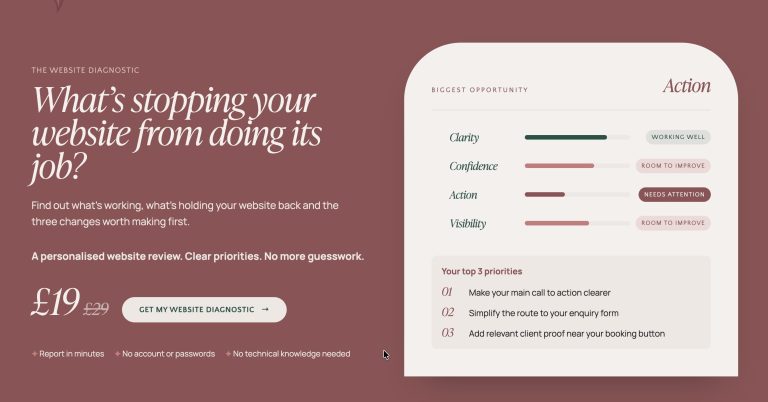
If you’d like a second pair of eyes on what your website is actually doing for you, a Website Audit is a good place to start. It shows you where the site is working, where it isn’t, and what to look at first.