The 13 books that shaped how I build websites that work
I read a lot. Some books I forget by the following week. Others change how I work.
These are the second kind.
They’re not a list of “books every entrepreneur should read”. They’re the books whose ideas I still use when I’m planning a website, shaping a brand or deciding whether a new tool is genuinely useful. I’ve grouped them around the four jobs in my Website That Works™ Framework, because that’s where their thinking is built into my work.
If you’re trying to work out why your own website isn’t doing as much as it could, any one of them is a good place to start.
Clarity: helping people understand you
This Is Marketing by Seth Godin
Godin’s big idea is that marketing isn’t about shouting to everyone. It’s about serving a specific group of people so well that they’d miss you if you were gone.
For a website, that means you can’t be all things to all people. A homepage that tries to speak to everyone usually connects with no one.
It’s made me much more comfortable with the idea that a website doesn’t need to appeal to everyone. In fact, I’d rather help a client connect brilliantly with 100 of the right people than attract 1,000 visitors who were never going to buy from them.
Building a StoryBrand by Donald Miller
Miller’s framework puts your customer, not your business, at the centre of the story. You’re the guide; they’re the hero.
It’s one of the most practical books I know for website messaging. If your homepage opens with “We are…” rather than the problem your client wants solving, this book will change how you write it.
One of the first things I look at when reviewing a homepage is whether it’s talking about the business or the person visiting it. Your qualifications, experience and achievements absolutely matter, but your potential client needs to understand what’s in it for them first.
Obviously Awesome by April Dunford
Positioning is the bit most small businesses skip and it’s why so many websites feel vague. Dunford breaks it down into something you can actually work through: who you’re best for, what you’re compared with and what makes you the obvious choice.
This thinking sits right at the start of every brand and strategic website project I take on.
One question I keep coming back to is: why would someone choose you over the alternatives? Not because you’re passionate or offer a great service, but because there’s something about what you do, who you do it for or how you deliver it that makes you the right choice.
Confidence: helping people trust you
Designing Brand Identity by Alina Wheeler
This is the reference book I keep coming back to. Wheeler shows how strategy, identity and consistency fit together and why a brand is so much more than a logo.
It’s a reminder that confidence is built through consistency: the same feeling everywhere someone meets your business.
I always tell clients that their brand needs to be recognisable wherever someone comes across it. Whether that’s Instagram, their website, a business card or printed materials, everything should feel connected. When your branding is consistent, people start to recognise and remember you, and that familiarity helps build trust.
Show Your Work! by Austin Kleon
A short book with a simple idea: share your process, not just the finished result. People trust what they can see.
It’s one of the reasons my case studies show what wasn’t working and the decisions we made, not just a pretty screenshot at the end. See the case studies.
I’m much better at showing the finished website than talking about everything that went into creating it. This book reminded me that the thinking, problem-solving and decisions along the way are often the most interesting parts. It’s something I’m making a conscious effort to share more of.
Playing Big by Tara Mohr
Mohr writes about the inner critic that stops talented women from putting themselves forward. I see the same pattern in websites: brilliant businesses hiding behind cautious, apologetic copy.
Confidence works both ways. Your clients need to trust you and you need to feel proud sending people to your website.
I’ve worked with so many incredibly capable women who struggle to see themselves as the experts they are. Sometimes they’re reluctant to use their own photograph, talk about their achievements or charge what they’re worth. A website can’t create that confidence on its own, but having something you’re genuinely proud to share can make an enormous difference.
Act: helping people know what to do next
Don’t Make Me Think by Steve Krug
The classic book on usability and still one of the best. Krug’s point is simple: every moment a visitor spends puzzling over your website is a moment they might leave.
Clear navigation, obvious buttons and pages that answer the question someone arrived with. That’s the heart of the Act part of my framework.
I often tell clients that we need to make it ridiculously easy for someone to find what they’re looking for. If visitors have to hunt around to understand what you offer, how much it costs or how to get in touch, we’re making them work too hard. And people simply won’t bother.
Visibility: helping people find you
They Ask, You Answer by Marcus Sheridan
Sheridan’s approach is wonderfully practical: find the questions your customers actually ask and answer them honestly and fully on your website.
It’s the foundation of good SEO, and it matters even more now that AI tools look for clear, trustworthy answers when they recommend businesses. More on that in what AI search means for your business.
I encourage clients to think about the questions they answer over and over again in emails, discovery calls or conversations. Those questions are often the starting point for some of the most useful content on their website. If one person is asking, chances are others are searching for the answer too.
Everybody Writes by Ann Handley
Most website problems are really writing problems. Handley makes writing feel learnable rather than intimidating, with plenty of practical advice on being clear, useful and human.
I always come back to the idea that writing for a website isn’t about sounding clever or professional. It’s about being understood. I’d much rather read a straightforward explanation of what someone does than three paragraphs of impressive-sounding words that don’t actually tell me anything.
Useful AI, not fashionable AI
Co-Intelligence by Ethan Mollick
One of the most balanced books on working with AI. Mollick treats it as something to experiment with thoughtfully, keeping humans in charge of judgement and taste.
It sums up how I approach AI: use it where it genuinely helps, never at the expense of your expertise or voice. Read how I use AI in my design process.
AI has become part of my everyday working process, but I’ve learnt that the quality of what comes out depends enormously on what you put in. I use it to explore ideas, challenge my thinking and speed up repetitive tasks, but I don’t hand over the strategy or the final decisions. That’s where my experience matters.
Three that shaped how I work with people
How to Win Friends and Influence People by Dale Carnegie
Written in 1936 and still relevant. Be genuinely interested in people, listen properly and remember what matters to them. Good client work starts with good conversations.
I’ve always believed that the best way to understand a business is to listen to the person behind it. Some of the most useful things clients tell me come out of conversations that have nothing to do with websites. Understanding what matters to them, what frustrates them and what they’re trying to achieve makes me a much better designer.
Remarkably Easy by Danielle Macleod
A reminder that the simplest approach is often the most effective, and that small, sustainable steps beat big bursts of effort.
Running a business can become unnecessarily complicated, especially when technology is involved. I’m always looking for ways to simplify things, whether that’s reducing the number of steps someone takes to make an enquiry or giving a client a website they can actually manage themselves. Simple doesn’t mean basic. It means removing what’s getting in the way.
Zero to One by Peter Thiel
Thiel argues that real progress comes from doing something different, not slightly better. For a small business, that’s a positioning lesson: don’t try to out-compete everyone on the same terms. Find where you’re the obvious choice.
I see so many businesses looking at their competitors’ websites and wanting something similar, only better. But what if the answer isn’t to look more like your competitors? What if it’s to understand what makes your business different and build everything around that? That’s a much more interesting starting point for a website.
The thread running through all of them
Put these books side by side and the same idea keeps appearing: be clear about who you’re for, earn their trust, make the next step easy and show up where they’re looking.
That’s exactly what a website needs to do, and it’s why I created the Website That Works™ Framework.
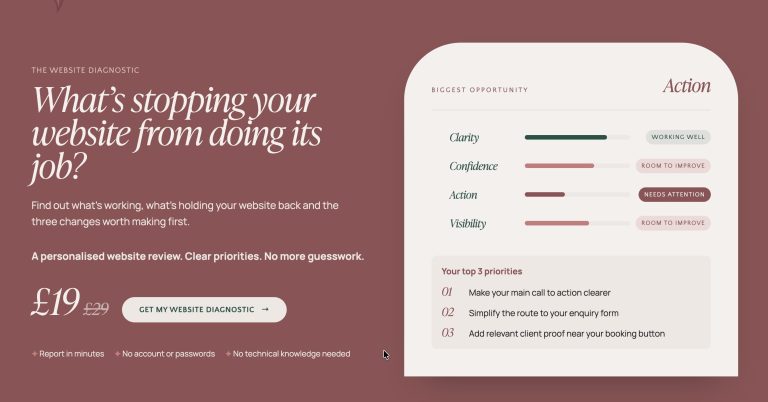
If you’d like to know which of those four jobs your website is struggling with most, start with the £19 Website Diagnostic. Or if you’re ready for a website built around this thinking, let’s talk about your project.
What would you add to the list? I’m always looking for my next good read.